Company culture: why it matters and where it happens
By Paul Suzman, OfficeLease
What E.O. Wilson’s ants teach us about tribes, brands and the office as a modern longhouse.
E.O. Wilson was arguably the world’s foremost authority on myrmecology, the study of ants. He was a prolific, Pulitzer-winning author and is widely regarded as the father of sociobiology.
What, a reasonable reader might ask, has the social life of ants to do with commercial real estate? Could it be the similarity between the design, construction and occupancy of the extraordinarily sophisticated termite mound and human behavior in urban high-rise buildings? (In Harare, Zimbabwe, there is a mid-rise office complex, Eastgate Center, modeled on the “ant hill,” embracing passive cooling concepts and using only a fraction of the energy of a typical office building.)
Actually, the focus of this article, while touching on built environments, is more about cultural norms and the value of place.
Dr. Wilson’s book The Social Conquest of Earth revisits one of his long-held views about the primacy of kin vs. group selection and re-emphasizes the importance of The Group in the extraordinary evolution of our species. He points out, with a certain relish, that the ant’s biomass on this planet is several times greater than that of humankind, and one senses he would not be displeased were they the dominant species.
Like ants, wasps, meerkats and cape hunting dogs, humans are genetically hard-wired for tribalism and innately disposed to embrace our groups. Once we join a “group,” whether as a Seattle Sounders fan, a congregant, a book club member, a cycling peloton, a Seattleite, a Washingtonian or a United States citizen, we tend to regard our group as superior to other (competing?) groups.
Likewise, we choose cars, coffee, footwear, neighborhoods and smartphones with similar motivations: that our choices are, within budget, superior to the alternatives. And that there is a group that agrees with us, a group with whom we identify. Our choices say something about us.
Another interesting characteristic of most groups is that they rally around an identifying banner or brand. The (former) British Empire, Holiday Inns, the Catholic Church and Starbucks, diverse examples, each embrace unique traditions, architecture, logos and rituals that are predictable, consistent and distinct. These are the qualities we expect of the brands we choose.
Notice the interlocking pattern?
Which brings us to company culture, and why we, as tenant representatives, are so interested in it.
Why physical space matters in 2026
With the advent of the internet, many predicted that most of us could effectively telecommute, that the need for people to congregate daily was obsolete. Technically, that might be correct. And the pandemic forced many to fall back on the internet, and verbs such as Zoom became ubiquitous. Post-Covid, the business world still wrestles with the right balance of remote vs. in-person work. Employers and employees need to reckon with people’s need to socialize with their “other families”; to collaborate; to be inspired by the presence of others with shared energy and purpose, if not identical missions. Especially when the physical environment reflects shared values and a sense of productivity.
Recent demographic and workplace trends reinforce this reality:
- Living alone: In the United States, the share of adults living alone has risen from 28% in 2011 to approximately 30–31% in 2026, according to U.S. Census and Pew Research estimates. Seattle “boasts” 44% single-person households, much higher than Bellevue, which mirrors the national average, and similar to Scandinavia, where single-person households remain the highest globally, with 45–48% of adults living alone.
- Views on marriage and children: Only 39–41% of Americans now say children are essential to a successful marriage, a continuation of the long-term decline. Across East Asia, birth rates have fallen further. In Taiwan, South Korea and Japan, surveys show majorities of women under 50 expressing reluctance to have children, driven by economic pressures and shifting cultural norms.
- Single-parent households: Roughly 23–25% of U.S. children now live in single-parent families, the highest rate among OECD nations.
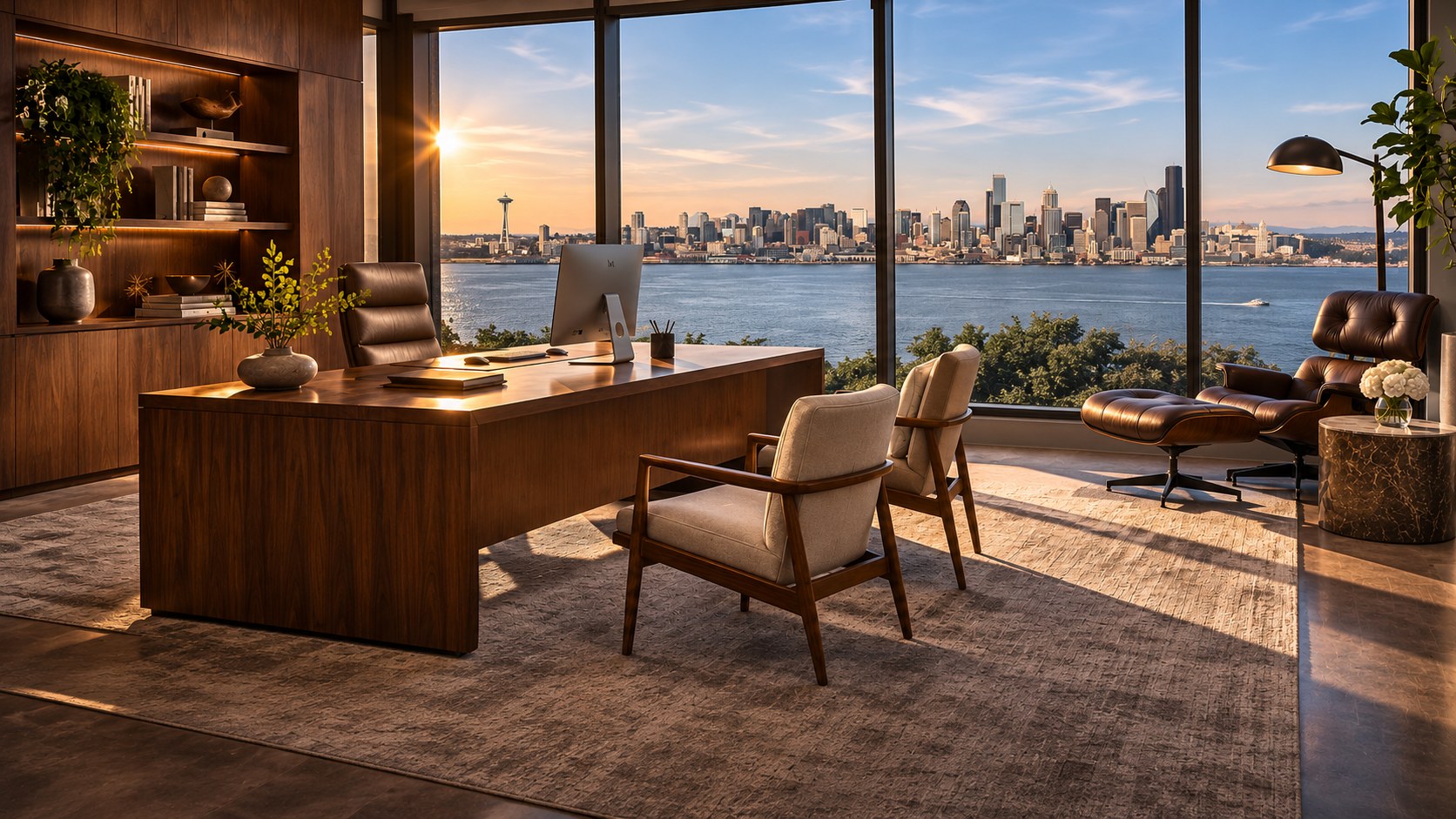
These trends underscore a profound shift: increasingly, co-workers become extended families, and the workplace becomes a tribal “longhouse.” I like to refer to clients’ offices as their clubhouse: a gathering place which fosters the creative friction of collaboration that is the mortar with which a culture is built.
Returning to Dr. Wilson’s premise: while a selfish individual might prevail over a single altruist, groups of altruists working together will outperform “selfish groups.” In that regard, the office environment plays a significant role in encouraging the collaboration that marks winning organizations.
This is why company culture matters, and why the physical or built environment in which it is fostered matters just as much. This African adage applies:
“If you want to go fast, go alone. But if you want to go far, go together.”